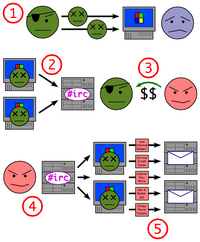
Botnet is a jargon term for a collection of software robots, or bots, which run autonomously and automatically. They run on groups of "zombie" computers controlled remotely by crackers. This can also refer to the network of computers using distributed computing software.
While the term "botnet" can be used to refer to any group of bots, such as IRC bots, the word is generally used to refer to a collection of compromised computers (called zombie computers) running programs, usually referred to as worms, Trojan horses, or backdoors, under a common command and control infrastructure. A botnet’s originator (aka "bot herder") can control the group remotely, usually through a means such as IRC, and usually for nefarious purposes. Individual programs manifest as IRC "bots". Often the command and control takes place via an IRC server or a specific channel on a public IRC network. A bot typically runs
hidden, and complies with the RFC 1459 (IRC) standard. Generally, the perpetrator of the botnet has compromised a series of systems using various tools (exploits, buffer overflows, as well as others; see also RPC). Newer bots can automatically scan their environment and propagate themselves using vulnerabilities and weak passwords. Generally, the more vulnerabilities a bot can scan and propagate through, the more valuable it becomes to a botnet controller community. The process of stealing computing resources as a result of a system being joined to a "botnet" is sometimes referred to as "scrumping".
Botnets have become a significant part of the Internet, albeit increasingly hidden. Due to most conventional IRC networks taking measures and blocking access to previously-hosted botnets, controllers must now find their own servers. Often, a botnet will include a variety of connections, ranging from dial-up, ADSL and cable, and a variety of network types, including educational, corporate, government and even military networks. Sometimes, a controller will hide an IRC server installation on an educational or corporate site, where high-speed connections can support a large number of other bots. Exploitation of this method of using a bot to host other bots has proliferated only recently, as most script kiddies do not have the knowledge to take advantage of it.
Several botnets have been found and removed from the Internet. The Dutch police found a 1.5 million node botnet and the Norwegian ISP Telenor disbanded a 10,000-node botnet. Large coordinated international efforts to shut down botnets have also been initiated. It has been estimated that up to one quarter of all personal computers connected to the internet are part of a botnet